

The Vagus Nerve: The Body's Master Regulator and Healing Power
In this exclusive interview published in the July & August 2026 issue of VOGUE Turkey, Holistic Health and Ayurveda Expert Ebru Şinik explains the vital role of the Vagus Nerve and parasympathetic nervous system in mind-body balance. Read the full interview to discover how to prevent stress-induced chronic illnesses by stimulating the Vagus nerve—the body’s master regulator—along with practical daily routines supporting holistic health and all the essential details regarding vagal wellness.
1. What is the vagus nerve? Where is it located in the body? What exactly does "parasympathetic nerve" mean? As a wellbeing expert, how would you define the importance of the vagus nerve in a single sentence?
The Body's Master Regulator and Overseer: The VAGUS Nerve
The Vagus is the longest of the 12 cranial nerves emerging from the brain stem. Possessing the widest and most intricate distribution area among these nerves, the Vagus Nerve regulates numerous fundamental physiological functions by extending its nerve fibers to all major organs like the roots of a grand tree. Originating in the brainstem, it travels progressively through the neck, chest cavity, heart, and stomach, extending down to the digestive tract. Along its pathway, it gives off branches to thoracic organs such as the root of the tongue, pharynx, larynx, trachea, esophagus, heart, and lungs, as well as abdominal organs like the stomach, liver, and intestines.
The Vagus is the primary pillar of the "Parasympathetic System," housing 75% of all nerve fibers belonging to this network. Directly associated with the right hemisphere of our brain, the Vagus is the main nerve of the parasympathetic nervous system, which is responsible for relaxation, rest, digestion, rejuvenation, cellular regeneration, and overall equilibrium in human physiology. The Vagus is also directly responsible for Heart Rate Variability (HRV).
We can define the Vagus Nerve as "the ultimate master regulator traveling every corner of the body with a staff in hand, tasked with witnessing imbalances and harmonizing them."
What is the Parasympathetic Nervous System?
Our brain consists of two lobes: the right and left brain hemispheres. The right hemisphere represents the Parasympathetic Nervous System—the restorative and calming division of the autonomic nervous system. The parasympathetic nervous system is defined as the autonomic nerve of rest, digestion, detoxification, repair, nourishment, reproduction, compassion, and empathy.
The Bridge of Consciousness
Furthermore, while the Vagus serves as a bridge between our sympathetic and parasympathetic nervous systems, it also acts as a vital gateway between our conscious mind and the subconscious.
Importance from a Wellbeing Expert Perspective
Considering our current societal psychology and global health statistics, stimulating the vagus nerve daily through correct methods is not only a solution for individual health but also the most effective and entirely cost-free intervention for general public health. By incorporating simple yet science-backed protocols known as Vagal Stimulators as daily routines, we can prevent up to 95% of chronic diseases directly linked to stress and vagal impairment before they even manifest, and significantly support the body and mind during the healing process.
2. We see a lot of content about the vagus nerve on social media lately. Like the gut-brain axis in recent years, it became a hot topic. It entered our agenda like an old yet new player in the brain-body relationship. What do you attribute this rise to? After all, this nerve isn't news to science…
Prior to the pandemic, probably 98% of the world's population had never heard the name of the vagus nerve or had no idea where it was located. I first encountered it in 2011 while studying Ayurveda and Preventive Medicine in the USA. In fact, my first book, Nefeste Saklı Hayat (Life Hidden in Breath), published in 2016, is a practical handbook entirely dedicated to nasal breathing techniques designed to balance and restore this nerve.
Following the events of 2020, the global medical community clearly recognized that boosting the immune system and preventing chronic illnesses cannot be achieved solely by taking nutritional or mineral supplements, or through diet and exercise alone. The Vagus is just as decisive for our autonomic nervous system balance as the digestive system... Therefore, beyond integrative and functional medicine doctors who approach human health holistically, the conventional Western medical world has also actively emphasized the importance of the Vagus Nerve over the past 5 years under Immune System Boosting Recommendations.
For physicians in conventional medicine who researched and understood the concept, the pandemic served as a true milestone toward embracing a holistic perspective on human health.
Scientists remark on the vagus nerve: “It may be the single organ in our body with the greatest connection to happiness and peace.”
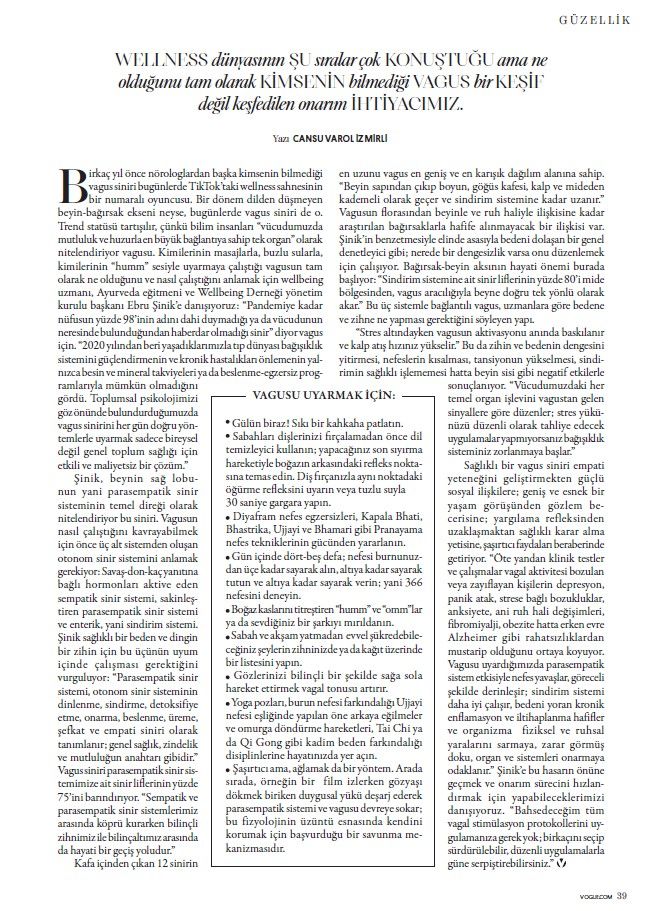
3. We see the vagus nerve being somewhat oversimplified on social media. “Optimize your vagus health with a 2-minute massage...” Is such a thing really possible? What is the complex side of the vagus nerve that the average person doesn't see?
Although the Vagus possesses a highly complex neural network from a straightforward standpoint, it can be stimulated in numerous ways precisely because of this feature. While two minutes might sound like an exaggeratedly short timeframe, doing even 2 minutes is often a great start to reset to factory settings rather than doing nothing at all.
Every year, new organs communicating with the Vagus or new physiological processes influenced by it are discovered. As the secrets of the Vagus are unlocked, new doors of hope open for managing and resolving chronic pain, inflammation, stress, anxiety, psychosomatic disorders, and autoimmune conditions—in short, countless health challenges.
The Vagus is the primary regulator of the "gut-brain axis," which describes the bidirectional communication between the brain and the digestive system—a concept that has deeply entered our daily vernacular over the last decade.
The Vagus is composed of sensory and motor fibers branching out to many organs in the body, including the gastrointestinal, cardiovascular, immune, and respiratory systems, as well as the ears, mouth, and vocal cords (Chang, Mashimo & Goyal, 2003; Kandel, Schwartz & Jessel, 2000).
In other words, the Vagus plays a starring role in maintaining homeostatic balance necessary for life. Alongside this essential function, it exercises control over inflammation, mood, and pain perception (Yuan et al., 2015). It exerts an incredible influence on physical, emotional, and mental health alike; indeed:
4. We know that the vagus nerve is a part that manages the body's “rest and digest” mechanism. But what exactly does this mean? Which regions and systems of the body is this nerve connected to?
To provide a comprehensive answer, I find it essential to summarize the main wheels of the system clearly:
The Autonomic Nervous System consists of three distinct subsystems: the parasympathetic nervous system, the sympathetic nervous system, and the enteric nervous system.
- Sympathetic Nervous System: Enables us to take action; it primarily deals with activating hormones associated with the “fight, flight, or freeze” response. It prepares our body for tasks and responds to threats or danger by releasing adrenaline, accelerating heart rate, increasing respiration rate, elevating blood pressure, and directing blood flow to limb muscles. This “ready-for-action” system consumes immense energy, releases free radicals, and heightens inflammation—the greatest enemy of our health. Thus, constant stimulation of the sympathetic nervous system throughout the day weakens our immunity, leaving us vulnerable to disease.
- Parasempatik Nervous System: Counterbalances the energy-burning sympathetic system with its calming, relaxing, and restorative effects. As the battery-recharging division, the parasympathetic system slows heart rate and breathing, creates mental tranquility, enhances digestive activity, replenishes energy reserves, repairs cells, and reduces systemic inflammation. It is also responsible for sexual arousal, healing, longevity, and well-aging functions.
- Enteric Nervous System (Digestive System): Described as the home of the immune system by Ayurvedic medicine for thousands of years, conventional medicine historically viewed the digestive system largely through food breakdown, waste elimination, and sending hunger/fullness signals to the brain. However, this narrow view fails to explain why 80% of nerve fibers belonging to the digestive system flow unilaterally from the stomach region upward to the brain via the Vagus Nerve. This is where the vital importance of the Gut-Brain Axis begins.
We require all three subsystems of the Autonomic Nervous System to live and fulfill our life responsibilities; however, for a healthy body and a tranquil mind, they must operate in harmony and balance.
When we stimulate the Vagus, parasympathetic activation slows and deepens our breathing, optimizes digestive function, reduces exhausting systemic inflammation, and allows the organism to focus on healing physical and emotional wounds and repairing damaged tissues, organs, and systems.
5. What does the wear and tear of the vagus nerve mean for an active individual in daily life? Could this be an indicator that other functions in the body are not operating healthily?
When you enter a state of stress, vagal activation is instantly suppressed and heart rate rises. This triggers mind-body imbalance, short and rapid breathing, elevated blood pressure, compromised digestive health, and eventually symptoms like brain fog. This occurs because every major organ in our body adjusts its operations based on signals received from the vagus nerve.
If you lead a highly stressful life without practices to regularly discharge this stress load, cumulative oxidative stress in the physiology increases over time, straining and sensitizing the immune system.
Consequently, the vagus nerve exercises absolute influence over homeostasis—the body’s ability to maintain internal stability against fluctuating environmental factors. Balanced homeostasis allows individuals to preserve optimal equilibrium amidst environmental changes, preventing cumulative stress-induced oxidative overload. Therefore, vagal stimulation exercises serve as primary determinants of your holistic health and happiness.
6. What kind of relationship exists between the vagus nerve and stress levels? Can stimulating the vagus nerve truly relax a person?
“The healing, calming branch of the nervous system is the parasympathetic nervous system. Activity levels in this system can be measured using natural breath-driven fluctuations in heart rate, which calculate Heart Rate Variability (HRV). As the diaphragm lowers during inhalation, the sympathetic system activates (acceleration/tension); as the diaphragm rises during exhalation, the parasympathetic system engages (deceleration/relaxation).”
Left brain hemisphere & Sympathetic Nervous System are active.
Right brain hemisphere & Parasympathetic Nervous System are active.
In short, heart rate increases as we inhale and decreases as we exhale. Altering the pace and pattern of our breath directly reflects changes in nervous system activity, thereby influencing Heart Rate Variability (HRV).
Furthermore, the vagus not only acts as a bridge between sympathetic and parasympathetic systems, but also serves as a vital pathway between the conscious mind and the subconscious.
Vital Benefits of a Healthy Vagus Nerve
Scientific studies demonstrate that healthy vagal nerve tone is critical for developing the following human capacities:
- Enhanced empathy and the ability to build strong social bonds
- Gaining a broader, more flexible perspective on life
- Observing events and situations without judgment, purely as a witness
- Making sound decisions during complex situations
Clinical tests and studies reveal that individuals with impaired or weakened vagal activity frequently suffer from depression, panic attacks, stress-related disorders, anxiety, mood swings, fibromyalgia, obesity, and even early-stage Alzheimer's disease.
7. Is it possible to optimize the health and function of the vagus nerve? What can be done to improve vagal health? As a wellbeing expert, do you practice certain techniques on your own body in this regard?
Absolutely, and the good news is that it is much simpler than you might think!
For nearly 15 years, I have spent about 10 minutes every morning practicing nasal breathing exercises—known in Vedic terminology as Pranayama—that stimulate the vagus nerve. They have become an integral part of my existence. Otherwise, I honestly don't know how I would navigate the daily stresses of modern life!
Below are examples of accessible Vagal Stimulation Protocols. You do not need to perform all of them. Simply select a few that fit comfortably into your lifestyle and scatter them throughout your day. Even if you choose to practice just one, remember that consistency and daily sustainability are key to reaping the benefits.
DAILY VAGAL STIMULATION PROTOCOLS
- Laugh Plentifully: Hearty laughter directly triggers vagal activation.
- Practice Tongue Scraping in the Morning: Use a tongue scraper before brushing your teeth. The final scraping stroke should reach the back of the throat (reflex point) to stimulate the vagus nerve. Alternatively, gently touch the back of your throat with your toothbrush to stimulate the gag reflex, or gargle with warm salt water for 30 seconds.
- Perform Diaphragmatic & Pranayama Exercises: Regularly practice diaphragmatic breathing alongside ancient pranayama techniques such as Kapalabhati, Bhastrika, Ujjayi, and Bhramari.
- Practice the 3-6-6 Breathing Pattern: Recommended 4–5 times a day for 10 breath cycles. Inhale through your nose for a count of 3, hold for a count of 6, and exhale for a count of 6.
- Hum or Chant: Make "Hummm" or "Ommm" sounds to vibrate the laryngeal muscles, or hum your favorite song.
- Remember Gratitude: Every morning upon waking and every night before bed, reflect on or write down what you are grateful for in life.
- Perform Eye Movement Exercises: Consciously moving your eyes side to side stimulates vagal tone.
- Explore Ancient Body Awareness Disciplines: Engage in Yoga postures (especially forward/backward bends and spinal twists accompanied by nasal or Ujjayi breathing), Tai Chi, or Qi Gong.
- Crying: Here is an interesting physiological insight: while I don't wish sadness upon you, shedding tears discharges accumulated emotional load, activating the parasympathetic system and vagus nerve. This is a natural defense mechanism the body employs to protect itself during emotional distress. Naturally, prolonged and repetitive crying can eventually exhaust the system.
Ebru Şinik
Founder of Yükselen Çağ Wellbeing Academy & Board Chair of Wellbeing Association
Begin Your Wellbeing and Longevity Journey
Click below to explore and specialize in ICF-accredited Biointegrative Breath Therapist, Wellbeing Specialist, and Longevity Routines, Nutrition, and Supplementation Coach certification programs offered at Yükselen Çağ Wellbeing Academy.
Explore Certification Programs